In the jewellery industry, precision is not a best practice — it is the foundation of profitability. Saudi Arabia is one of the most dynamic jewellery markets in the world, driven by cultural tradition, bridal seasons and a retail sector expanding under Vision 2030. Yet behind the display cases of many successful showrooms sits an operational vulnerability: reliance on manual spreadsheets and legacy software to manage millions of riyals in physical assets.
In a tightly regulated digital economy, running a jewellery business on Excel or generic accounting software is not merely inefficient; it is a liability. Spreadsheets cannot adjust to the live gold rate, cannot securely track scrap metal moving through workshops, and cannot communicate natively with the Zakat, Tax and Customs Authority (ZATCA) for mandatory electronic invoicing.
The answer is to abandon fragmented manual methods and adopt an ERP designed specifically for precious metals. This guide explains the differences between standard ERPs and Gold ERPs, the operational problems a specialised system actually solves, and what to expect from a properly executed deployment.
The Paradigm Shift: Gold ERP vs. Standard ERP
When a retail business decides to digitise, the instinct is to buy a well-known generic ERP. For a clothing retailer or an electronics distributor, a standard ERP works well. The jewellery industry, however, operates on a fundamentally different physical and financial logic.
The Unit Problem: Pieces vs. Grams
In standard retail, inventory is tracked by the unit. A shoe store tracks one pair of shoes; the cost is fixed and the selling price stays fixed until a human decides to discount it.
In a jewellery business, a unit is rarely just a unit. A gold necklace is a composite of variable data points: a gross weight, a net gold weight, a stone weight, a karat purity (18K, 21K, 22K, 24K), a labour cost (making charge), and a metal cost that moves with global commodity markets.
Force standard software onto that reality and you are asking the system to treat a 50-gram 21K bridal set the way it treats a pair of socks. A specialised gold inventory system rather than a generic ERP understands weight-based, purity-dependent, market-linked inventory natively.
Feature Comparison – Standard ERP vs. Gold ERP
|
Operational feature |
Standard ERP (generic retail) |
Daysum Gold ERP (jewellery specific) |
|
Inventory measurement |
Counted by pieces, boxes or SKUs. |
Measured by gross grams, net grams, stone weight and karat purity. |
|
Pricing mechanism |
Fixed; manual updates required. |
Linked to live global gold rates; updates the entire catalogue automatically. |
|
Labour and costing |
Fixed generic overheads. |
Calculates making charges per gram, as a flat rate, or as a percentage. |
|
Scrap and exchanges |
Processed as a standard return. |
Values scrap based on melt value, purity testing and the daily rate. |
|
ZATCA compliance |
Requires complex manual configuration. |
Native Phase 2 integration; generates compliant invoices and QR codes at the POS. |
|
Financial reporting |
Sales and revenue only. |
Purity movement, metal gain and loss, artisan wastage and real-time vault valuation. |
The Five Core Problems Solved by Gold ERP
Moving to a specialised system removes the daily operational problems that keep jewellery store owners awake at night. Here are the five most critical.
A. Complex Tracking: Escaping the Inventory Nightmare
Jewellery inventory is notoriously difficult to manage. A single showroom may hold thousands of unique pieces, many of which look nearly identical to the untrained eye. Spreadsheets require manual entry, which produces phantom inventory — items that exist on paper but not in the vault, or the reverse.
A Gold ERP changes tracking entirely. Each item is registered with photos, exact gross and net weights, and supplier details. More importantly, modern Gold ERPs integrate with barcode and RFID jewellery inventory tracking. Instead of spending a weekend counting pieces by hand, a manager can scan a full display case in seconds with an RFID reader and reconcile physical stock against the digital record immediately.
B. Live Pricing: Protecting Your Profit Margins
The global gold price is in constant flux. If a jeweller prices a case of 21K chains in the morning and the rate rises 3% in the afternoon, selling at the morning price damages both the margin and the purchasing power needed to replace that stock.
Updating prices manually across hundreds of items in Excel is not realistic. A Gold ERP maintains a direct link to live bullion rates: when the rate changes, the system recalculates the retail price of every gold item in inventory — applying your making charges and target margins — so the POS always reflects the correct current price.
C. Karat Math: Instant Conversions and Scrap Valuation
In the Saudi market, jewellery exchange is extremely common. A customer may bring an old 18K bracelet to trade toward a new 22K necklace. Calculating the 18K to 24K conversion, factoring in melting loss and applying the current buying rate on a handheld calculator, is highly susceptible to human error.
A Gold ERP handles karat maths natively. The cashier enters the weight and karat of the scrap; the system calculates the pure gold equivalent, values it against the live buying rate, and applies that value as credit toward the new purchase — generating a clean audit trail across both the inventory and accounting ledgers.
D. ZATCA Compliance at the POS
Since the launch of the Fatoora programme by the Zakat, Tax and Customs Authority, invoicing requirements in Saudi Arabia have become highly demanding. Phase 2 (the Integration Phase) requires electronic invoices to be cryptographically stamped and reported to government servers.
Failing to comply carries escalating penalties, and forcing a legacy spreadsheet system to produce Phase 2 XML files is not realistic. With specialised ZATCA Phase 2 e-invoicing built into your Gold ERP, compliance becomes invisible: the cashier finalises the sale, and the ERP communicates with ZATCA and produces a compliant receipt with the required QR code in about a second.
E. Ironclad Security: Role-Based Access and Audit Trails
Internal theft and unauthorised discounting are silent killers in luxury retail. When several employees share a spreadsheet or a generic POS login, tracking who altered a price or deleted an inventory record is impossible.
A Gold ERP applies strict Role-Based Access Control. A sales representative can view prices and process sales but cannot change base making charges or delete an invoice. A branch manager can approve specific discounts, while only finance leadership can alter supplier accounts. Every login, inventory transfer and price adjustment is logged in a tamper-evident audit trail.
Ready to replace fragile spreadsheets with real control? Discover how Daysum’s Gold & Jewelry ERP System turns your showroom into a precision-run enterprise.
The Artisan Ecosystem: Mastering Karigar Management
One of the most complex and least documented areas of jewellery management is dealing with workshops and artisans (Karigars). Many jewellers issue raw 24K gold and loose gemstones to independent artisans who craft the final pieces.
Tracking that exchange on spreadsheets invites disputes. How do you track the exact weight of gold issued, the agreed acceptable wastage (metal dust lost during polishing), and the labour fees owed when the finished piece returns?
A capable Gold ERP includes a dedicated job work or manufacturing module. When raw metal is issued to a Karigar, the ERP removes it from your main vault and places it in a vendor vault inside the system. When the finished 21K jewellery is returned, the system calculates the purity conversion, deducts the agreed wastage allowance, registers the new finished inventory, and posts the labour cost directly to the artisan’s accounts payable ledger. A relationship previously governed by trust and memory becomes a documented, reconcilable supply chain.
The Daysum Advantage: Transforming Operations
Recognising the gap between what standard software provides and what Saudi jewellers need, Daysum has built an ecosystem for the gold vertical. Choosing Daysum is a partnership around weight-based inventory, not simply a software upgrade.
Multi-Branch Supremacy
For jewellers expanding across the Kingdom, managing multiple branches is a logistical challenge: Store A may be overstocked with white gold while Store B turns customers away. A professional Odoo ERP implementation in Saudi Arabia through Daysum provides a unified, centralised cloud database. Management can view real-time inventory and sales velocity across all branches at once, enabling informed inter-branch stock transfers.
Advanced Analytical Reporting
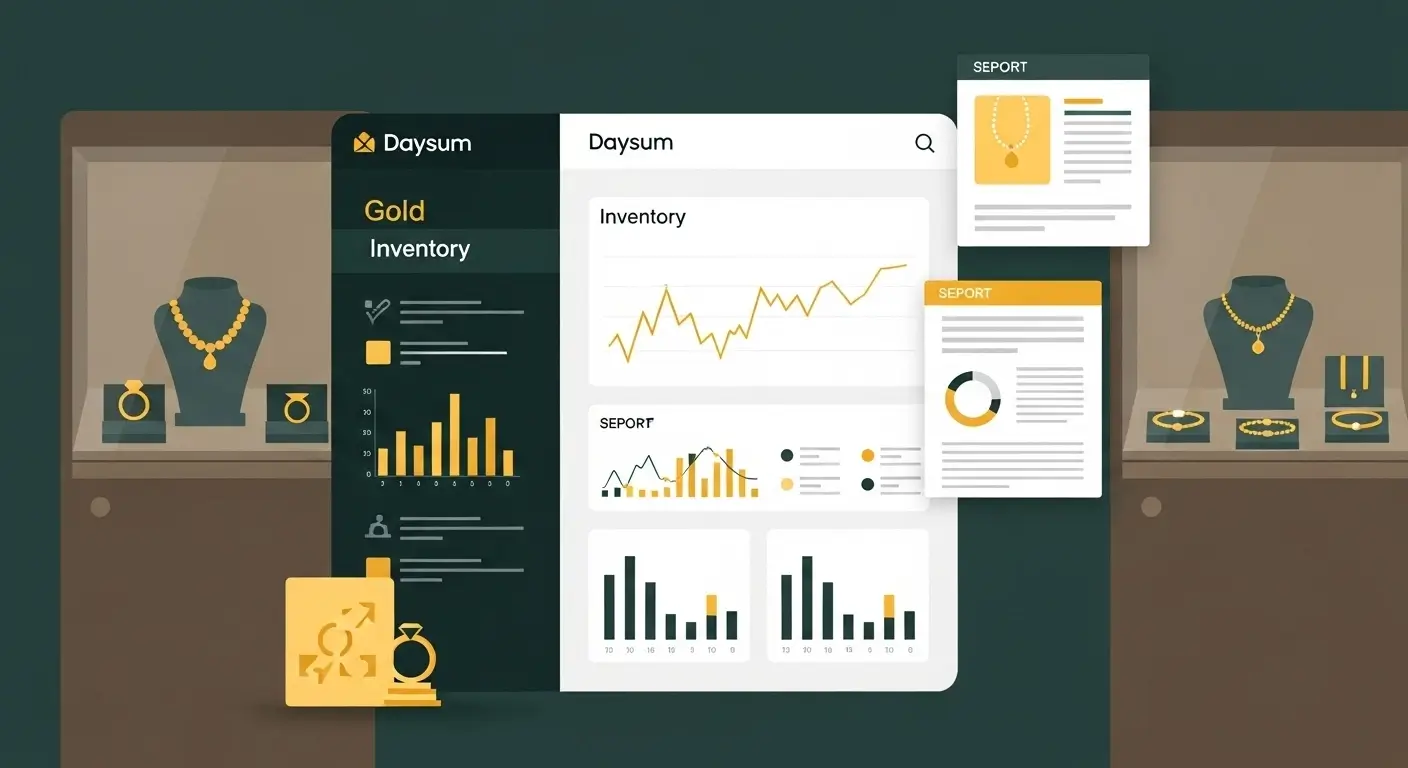
Spreadsheets look backward; a live system lets you look forward. Using specialised gold accounting software, owners gain executive dashboards that answer questions a generic report cannot:
- Which supplier’s designs are selling fastest?
- What is our exact metal gain or loss across all workshop activity this quarter?
- What is our total inventory valuation at the current gold rate right now?
Answering these consistently is what allows proactive purchasing decisions and better capital allocation.
Comprehensive Digital Ecosystem Integration
A jewellery business is more than a retail counter. Our Gold ERP integrates with omnichannel environments: whether you are launching a B2C e-commerce store, connecting to local payment gateways such as Mada and STC Pay, or streamlining inventory, sales and compliance across the jewellery operation, every digital touchpoint reports back to the same central accounting ledger.
Deployment, Scalability, and the Future of Jewelry Retail
The transition to a Gold ERP should be executed deliberately, and owners have real flexibility in how they deploy.
For smaller, agile operations or multi-branch retailers, cloud deployment is usually the better fit. It requires no upfront investment in physical servers, gives management secure access to real-time data from anywhere, and applies security patches and regulatory updates automatically.
For large wholesale distributors or enterprises with specific data-governance requirements, on-premise deployment keeps the servers holding sensitive financial data inside corporate headquarters.
Either way, the architecture is built to scale: you can add branches, integrate subsidiaries or launch new product lines without rebuilding on a different platform.
Conclusion
In a competitive, volatile and strictly regulated market, the margin for error in jewellery retail is very small. Managing millions of riyals in market-linked assets on fragile spreadsheets and generic, non-compliant software is no longer defensible.
A specialised Gold ERP replaces manual tracking with structure. It resolves karat conversions instantly, protects margins with live pricing, supports clean ZATCA-compliant invoicing, and gives you verifiable control over high-value inventory.
Daysum delivers that control for the jewellery sector, and turns compliance from a recurring headache into a background process — so you can plan against the market instead of reacting to it.
Ready to move beyond spreadsheets and secure the future of your jewellery enterprise? Contact Daysum today for a consultation and a Gold ERP configuration built around your karat structure, branch count and workshop model.
Frequently Asked Questions (FAQs)
A Gold ERP is integrated with a live API feed that monitors the global bullion market. Instead of manually changing the price of every necklace in your store when the gold rate changes, the ERP automatically recalculates the retail price of your entire inventory based on the new live rate, plus your pre-set making charges and profit margins.
Yes, this is a core feature. The system has a dedicated module for scrap metal. The cashier inputs the weight and karat of the customer's old jewelry, and the ERP instantly calculates its pure gold equivalent and its financial value based on your buying rate. This value can then be seamlessly applied as a credit toward their new purchase on a single, ZATCA-compliant invoice.
While data migration is a critical step, Daysum’s expert implementation team handles the heavy lifting. We take your existing Excel spreadsheets, clean the data to remove duplicates or errors, format it to match the ERP’s complex weight-based architecture, and securely upload it to the new system, ensuring you don't lose any historical data.
Every piece of jewelry is tagged with a tiny, discreet RFID microchip. Instead of taking hours to manually count and weigh every piece of jewelry during an audit, a manager simply waves an RFID scanner near the display cases. The scanner reads hundreds of tags per second and instantly cross-references the physical count with the digital inventory in the Gold ERP, identifying any missing items immediately.
Absolutely. The ERP features a comprehensive "Job Work" module. It meticulously tracks the exact weight of 24K raw gold you issue to an artisan, records the agreed-upon acceptable wastage (metal dust loss), and calculates the labor cost owed when they return the finished 21K or 18K pieces, ensuring perfect accountability for every gram of your metal.