In the fast-paced corporate environments of Riyadh, Dubai, and Cairo, managing a growing workforce is one of the most critical challenges a business faces. As B2B enterprises, manufacturing plants, and large-scale retail chains expand their operations, the complexity of managing human capital scales exponentially. Gone are the days when a simple spreadsheet or a manual punch-card could suffice. Today’s dynamic business models require employees to operate around the clock, necessitating a variety of overlapping schedules, flexible hours, and night operations.
When Human Resources (HR) departments attempt to manage these intricate schedules manually, the results are predictably disastrous: payroll leakages, soaring administrative overhead, and intense frustration among staff. The definitive solution to this modern operational bottleneck is the deployment of an advanced Personnel affairs software. By fully automating how businesses track time, manage schedules, and process financial compensations, companies can entirely eliminate human error. In this comprehensive guide, we will explore how leveraging an intelligent HRMS ecosystem powered by Odoo Community can automate complex Work shifts and Overtime calculations with a single click, permanently resolving financial disputes and fostering a culture of absolute transparency.
1. The Heavy Administrative Toll of Manual Work Shifts and Delays
Managing human resources in a large-scale B2B enterprise is fundamentally different from running a small office. Industrial factories, hospitals, and retail networks do not adhere to a standard nine-to-five schedule. Instead, they rely on complex Work shifts that include morning, evening, night, rotating, and sometimes split shifts.
Trying to align these erratic schedules with manual tracking mechanisms creates a severe administrative nightmare for HR managers.
- Tracking Delays: When an employee arrives late, calculating the exact minute of the delay and applying the corresponding grace period manually is incredibly tedious. Minor Delays often go unnoticed or unrecorded, which, when multiplied by hundreds of employees over a year, translates into massive financial losses for the company.
- Shift Swapping Confusion: Employees frequently swap shifts to accommodate personal emergencies. Without a centralized digital system, these swaps are often communicated via text messages or sticky notes, leading to confusion, understaffing during critical operational hours, and inaccurate end-of-month reporting.
- The Burden of Reconciliation: At the end of the month, HR personnel are forced to spend days cross-referencing messy paper logs against schedule printouts to determine who was actually present. This archaic process inevitably leads to errors, delays in salary disbursement, and a demotivated workforce.
To understand how top-tier organizations are moving past these hurdles, explore the top 5 features in attendance management software that are reshaping corporate HR.
2. Seamless Integration: From Fingerprint to Intelligent Attendance System
The first step in eradicating manual errors is capturing the raw data with absolute precision. Modern enterprises achieve this by deploying biometric technologies, most notably the Fingerprint scanner or facial recognition terminals. However, a biometric device is only as powerful as the software it communicates with.
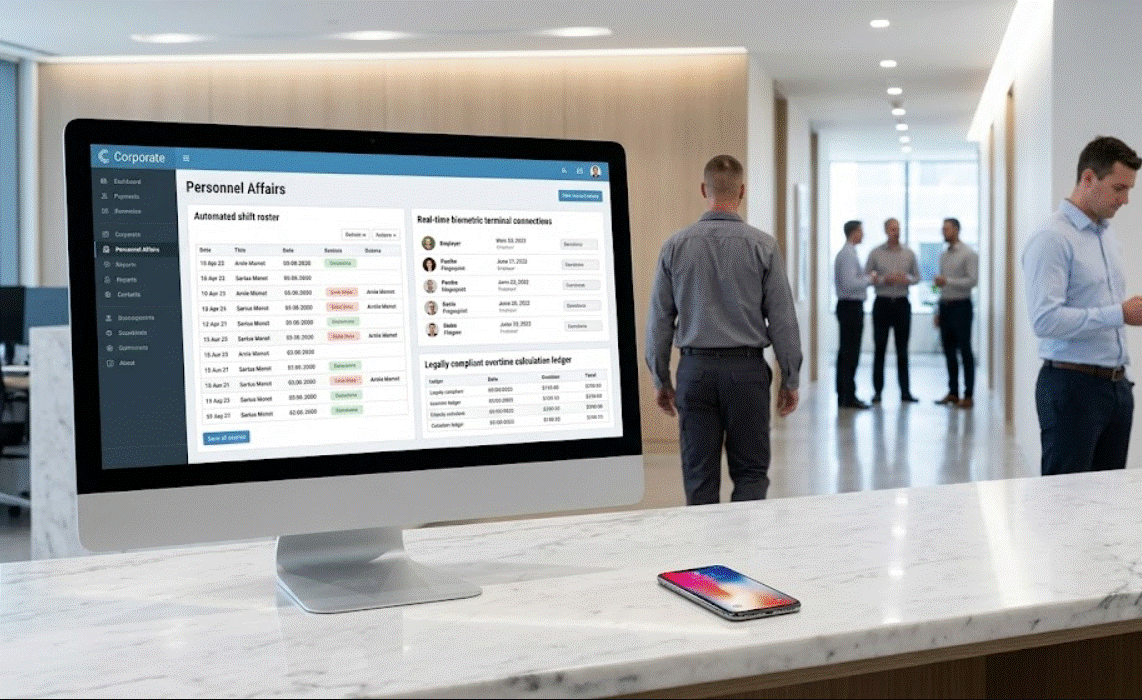
A sophisticated Personnel affairs software connects directly to these biometric devices via secure APIs. When an employee scans their Fingerprint at the factory gate or office entrance, the data is not just stored on a local machine; it is transmitted instantly to the centralized cloud database.
This creates a highly intelligent Attendance system that does the heavy lifting for you:
- Automated Shift Matching: The system instantly matches the employee’s punch-in time against their pre-assigned shift schedule. It automatically identifies whether the employee is on time, absent, or arriving for an unscheduled shift.
- Eradicating Time Theft: Biometric verification completely eliminates “buddy punching”—the practice where one employee clocks in for an absent colleague.
- Real-Time Dashboards: HR managers and department heads receive live dashboards showing exactly who is on the floor, who is late, and which departments are understaffed, enabling immediate, data-driven operational decisions.
Manual vs. Automated Attendance and Shift Management
| Operational Challenge | Manual / Disconnected Systems | Automated Personnel affairs software | Impact on Corporate Efficiency |
| Logging Daily Attendance | Vulnerable to buddy punching and human error. | 100% accurate biometric Fingerprint or facial recognition. | Completely eliminates time theft and ensures paying only for actual hours worked. |
| Tracking Employee Delays | Requires HR to manually calculate minutes and grace periods. | System automatically calculates Delays and deducts according to company policy. | Enforces strict discipline and saves hours of manual HR calculations. |
| Managing Work Shifts | Rigid paper schedules that fail to accommodate sudden changes. | Dynamic, drag-and-drop digital scheduling with instant employee notifications. | Ensures optimal staffing levels and smooth transitions between rotating shifts. |
| Data Synchronization | Data must be exported via USB from devices at the end of the month. | Real-time, cloud-based synchronization across all company branches. | Grants executives live visibility into workforce attendance across multiple cities. |
3. Mastering Labor Law and Overtime with Zero Friction
One of the most legally sensitive and mathematically complex aspects of HR management is calculating Overtime. In regions with strict regulatory frameworks, such as the Kingdom of Saudi Arabia, adhering to the national Labor law is not merely a best practice; it is a strict legal requirement to avoid crippling governmental fines.
The calculation of extra hours is fraught with variables:
- Does the extra time qualify as standard overtime (usually calculated at 150% of the basic hourly wage)?
- Did the employee work on a designated weekend or a public holiday?
- Was the overtime officially requested and approved by a direct manager, or did the employee simply stay late without authorization?
A robust Personnel affairs software removes the guesswork. It features a built-in “Rules Engine” that can be customized to reflect the exact stipulations of the local Labor law. When an employee clocks out late, the system flags the extra time. If the time aligns with a pre-approved overtime request in the system, it is automatically categorized, mathematically multiplied by the correct legal rate, and added to the employee’s financial ledger. This guarantees that your business remains 100% compliant with government regulations without requiring a calculator.
For an in-depth look at regulatory compliance, read our essential guide on how to ensure your HR system complies with Saudi labor laws.
4. The Ultimate Value for HR: Eradicating Financial Disputes
The most profound added value of automating shift and overtime calculations lies in the dramatic improvement of workplace morale and the total elimination of financial disputes. In a traditional setup, “payday” is often followed by a flood of complaints. Employees argue that their Overtime wasn’t fully compensated or that they were unfairly penalized for Delays they believe were justified.
These disputes consume an enormous amount of HR’s time, forcing professionals to dig through archives to prove or disprove a claim. An automated HRMS environment changes this dynamic entirely through Employee Self-Service (ESS) portals.
Through a dedicated mobile app or web portal, employees are granted complete transparency over their own data:
- They can view their daily attendance logs, exact punch-in/out times, and calculated Delays in real-time.
- They can track their approved Overtime hours as they accumulate throughout the month.
- If an employee forgets to scan their Fingerprint, they can instantly submit a “missing punch” request through the app, which their manager can approve with a single click.
By providing employees with this level of transparency, questions are resolved daily rather than snowballing into a massive confrontation at the end of the month. HR managers are transformed from “data entry clerks” and “dispute mediators” into strategic leaders focusing on recruitment, employee development, and corporate culture.
5. The Final Step: Seamless Payroll Calculation
The culmination of accurately tracking shifts, delays, and extra hours is the flawless execution of the monthly payroll. When systems are disconnected, HR must manually transfer attendance data into a separate financial program—a process rife with the potential for catastrophic double-entry errors.
An integrated Attendance system flows natively into the Payroll calculation engine. When it is time to run payroll, the system automatically aggregates all the data collected over the month:
- It starts with the employee’s base salary and fixed allowances.
- It automatically adds the exact financial value of all approved Overtime.
- It automatically deducts penalties for unauthorized Delays or unexcused absences based on the company’s internal penalty matrix.
- It applies necessary statutory deductions, such as social insurance (GOSI) or local income taxes.
With one click, the system generates perfectly accurate payslips for hundreds of employees simultaneously. Furthermore, the resulting financial data is automatically pushed to the company’s general ledger, ensuring that the finance department has an accurate, real-time view of labor costs.
To discover the software that makes this possible, review the best tools for attendance and payroll integration in Saudi Arabia.
The ROI and Strategic Benefits of Automated Payroll and Overtime
| Strategic HR Benefit | Technological Mechanism | Direct Value Added for B2B Enterprises |
| Zero Payroll Errors | Native integration between the biometric devices and the Payroll calculation engine. | Protects corporate capital from overpayments and guarantees employee trust. |
| Strict Legal Compliance | Pre-configured rules engine aligned with the national Labor law. | Shields the company from government labor disputes, fines, and legal liabilities. |
| Conflict Resolution | Employee Self-Service (ESS) portals providing real-time visibility. | Fosters a transparent culture and saves HR countless hours in end-of-month mediation. |
| Optimized Labor Costs | Automated approval workflows for extra working hours. | Prevents unauthorized overtime abuse and keeps departmental budgets strictly controlled. |
6. Empowering Your Business with Odoo Community
To achieve this absolute level of automation, corporations require an infrastructure that is both remarkably powerful and highly adaptable. This is why Odoo Community stands out as the ultimate foundation for modern Human Resource Management Systems (HRMS).
Unlike rigid, proprietary software that forces your company to adapt to its limitations, Odoo Community is an open-source framework. This means it can be deeply customized to reflect the highly specific, nuanced realities of your B2B operations. Whether your factory runs on a complex 4-shift rotating schedule, or you need to manage multiple corporate entities across different countries with varying tax laws, Odoo can be tailored to fit perfectly.
By partnering with a verified integrator like Daysum, you ensure that this powerful system is localized for your exact needs. Daysum provides the crucial bridge between Odoo’s vast capabilities and your daily operational requirements, ensuring that your biometric devices, payroll engines, and accounting ledgers operate as one harmonious organism. Learn more about how you can transform your operations with comprehensive HRMS cloud solutions from Daysum. For modern jewelers looking to increase profitability, we highly recommend reading about Daysum Vs Traditional Jewelry Software.
Conclusion
The era of managing your workforce through fragmented spreadsheets and manual calculations has officially passed. For businesses striving for excellence and aggressive growth, relying on human intervention to track Work shifts, monitor Delays, and calculate Overtime is an unsustainable risk. By adopting a comprehensive, automated Personnel affairs software linked directly to your Attendance system, you achieve operational perfection. You guarantee strict adherence to the Labor law, permanently eliminate end-of-month financial disputes, and streamline your Payroll calculation down to a single click. Embrace the power of an integrated HRMS through Odoo Community, and empower your HR department to stop crunching numbers and start building a more productive, motivated, and successful enterprise.
Frequently Asked Questions (FAQs)
An advanced Personnel affairs software provides dynamic scheduling capabilities. If an employee calls in sick, the HR manager or shift supervisor can instantly update the schedule on the dashboard. The system will flag the absence, automatically notify available replacement staff via the mobile app, and seamlessly adjust the Payroll calculation for both the absent employee and the colleague who covers the shift.
Yes, this is one of the distinct advantages of an automated system. The software’s rules engine is programmed with the exact parameters of the local Labor law. If a shift crosses midnight into a designated public holiday, the system splits the hours precisely. It applies the standard overtime rate for the hours before midnight and automatically applies the higher public holiday rate for the hours worked after midnight, ensuring absolute legal and mathematical accuracy.
Modern biometric attendance devices are designed to operate flawlessly offline. If the internet connection drops, the device will continue to record all employee punches and store the data safely on its internal memory. The moment the internet connection is restored, the device will automatically push the cached data to the cloud-based Attendance system, ensuring that no attendance records or Delays are ever lost.
In traditional setups, HR spends hours answering routine questions: "How many vacation days do I have left?" or "Why was my salary deducted?" With an ESS portal, employees have direct, secure access to their own data. They can view their time-logs, check their leave balances, request time off, and submit missing punch requests directly from their smartphones. By empowering employees to manage their own information, HR is relieved of these tedious administrative inquiries and can focus on strategic workforce development.