In the era of Saudi Vision 2030, digital transformation is not a luxury reserved for large conglomerates; it is a working requirement for businesses of every size across the Kingdom. As the Saudi economy diversifies and regulatory frameworks such as the ZATCA mandates grow more demanding, running a business on outdated, fragmented software leads to operational paralysis and financial penalties.
Odoo ERP is a dynamic, scalable and cost-effective Enterprise Resource Planning platform. It centralises complex business operations into one interconnected system, removing the need to juggle separate tools for accounting, human resources, retail point of sale and customer relationship management.
This guide explains the real cost of fragmented software, walks through Odoo’s core modules, examines why it suits Saudi SMEs specifically, and outlines what a customised implementation involves.
The Hidden Cost of Fragmented Software Systems
Before understanding the value of Odoo, examine the problem it solves: the silo effect. Historically, businesses adopted software reactively. Accounting needed to issue invoices, so they bought accounting software. Sales needed to track leads, so they bought a standalone CRM. Retail expanded, so they purchased an independent POS.
The Chaos of Data Silos
This reactive approach produces a fragmented infrastructure where departments speak different digital languages. The consequences are significant:
- Data duplication and human error: if a salesperson closes a deal in a standalone CRM, a finance clerk must re-enter that data into the accounting system to issue an invoice. Redundant entry produces typographical errors, mismatched figures and unhappy clients.
- Lack of real-time visibility: leadership cannot make timely decisions while waiting days for departments to consolidate spreadsheets into one coherent report.
- Rising IT costs: paying for multiple disconnected licences — a CRM subscription, an HR portal, a standalone inventory app — drains capital that could fund growth, and maintaining custom integrations between them consumes IT time indefinitely.
The Odoo Solution: A Single Source of Truth
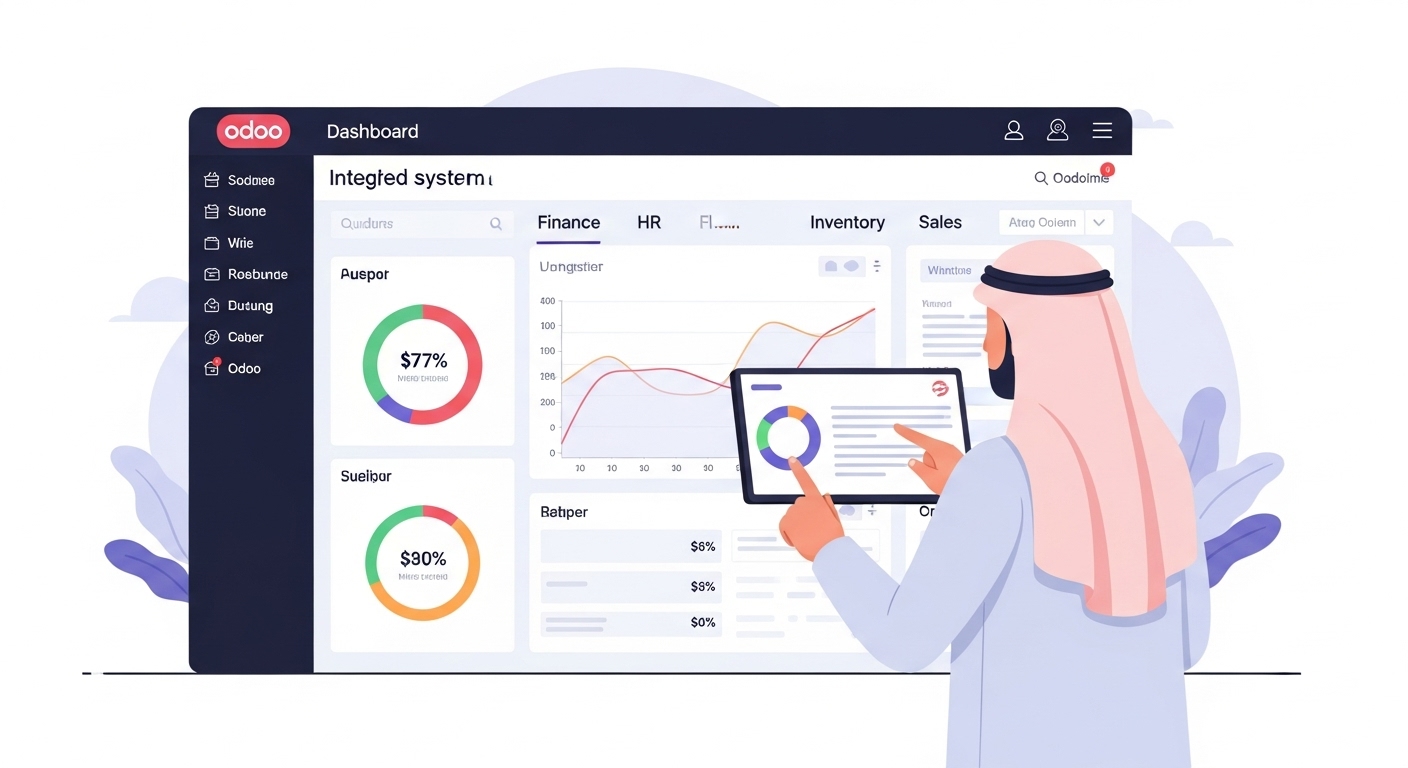
Odoo ERP removes that fragmentation through a unified database architecture. When a cashier completes a transaction in the Odoo POS, the inventory level drops, the cost of goods sold is recorded in the general ledger, and the customer profile updates in the CRM — in one motion, with no manual re-entry. Finance sees sales data immediately, HR links payroll directly to attendance, and one set of dashboards replaces several paid licences.
See every department in one glance: let Daysum architect a Centralized ERP Dashboard that finally gives you a single source of truth.
Demystifying Odoo’s Core Modules
Odoo offers a large suite of integrated business applications, but for most Saudi enterprises four core modules form the foundation of the transformation.
A. Advanced Financial Accounting and Invoicing
Accounting is the centre of any enterprise, and Odoo’s accounting module goes well beyond basic bookkeeping.
- Localised chart of accounts: Odoo supports an Arabic chart of accounts aligned to the standards recognised by the Saudi Organization for Chartered and Professional Accountants (SOCPA).
- Automated bank reconciliation: the system can sync with local Saudi banks and match large volumes of transactions using rule-based and pattern-matching reconciliation, sharply reducing manual matching work.
- ZATCA compliance: the most critical feature for KSA businesses. Odoo generates the required cryptographically stamped XML files and QR codes in the background. With expert ZATCA Phase 2 e-invoicing configuration, invoices clear and report correctly without slowing your billing process.
B. Human Resources (HR) and Payroll Management
Managing a workforce in Saudi Arabia means navigating detailed and specific labour regulations.
- Employee lifecycles: Odoo tracks everything from the recruitment pipeline and interview scheduling through onboarding, contract generation and daily attendance.
- KSA labour law automation: a generic HR system cannot handle local requirements. Through customised cloud HRMS solutions, Daysum configures Odoo to calculate End of Service Benefits, manage GOSI deductions and generate payroll files formatted for the Wage Protection System.
C. Point of Sale (POS) and Inventory Sync
For retail businesses, downtime is the enemy. Odoo’s POS is built to be fast, simple for staff and resilient.
- Offline capability: if a branch loses connectivity, the Odoo POS continues processing sales and printing receipts. When the connection returns, it syncs all transactions with the central database automatically.
- Multi-store management: whether you run two boutiques in Riyadh or fifty stores across the GCC, pricing, promotions and loyalty programmes are managed for all branches from one dashboard.
- Live inventory sync: a tailored deployment focused on streamlining inventory, sales and compliance means that when an item sells in Jeddah, the central warehouse in Dammam sees the stock drop in real time, triggering automated procurement rules that prevent stockouts.
D. Customer Relationship Management (CRM)
Sales drive the business, and Odoo’s CRM is built around sales growth rather than record-keeping alone.
- Visual sales pipelines: managers track every lead through customisable Kanban boards, moving prospects from new to qualified to won.
- Omnichannel communication: representatives send emails, SMS and messaging-app communications directly from the customer profile inside Odoo, so the full history is logged in one place.
- Automated lead scoring: the system assigns points to leads based on their interaction with your website and marketing emails, so the sales team concentrates on the most engaged prospects.
Why Odoo is the Ultimate Solution for Saudi SMEs
Small and medium enterprises form the backbone of the Saudi economy, yet traditional Tier-1 ERP systems are often prohibitively expensive and overly complex for them, requiring long implementation cycles. Odoo occupies the middle ground.
Affordable Modularity
You pay for the modules you need. A startup can begin with Sales and Accounting, then activate Manufacturing, E-commerce or Fleet Management as the business grows. You are never forced to buy a package built for someone else’s scale.
Flawless Arabic Localization
Software adoption fails when end users struggle with the interface. Odoo provides a native right-to-left Arabic interface with contextual, professional translation, so an Arabic-speaking workforce is comfortable navigating the system from day one.
Pre-Configured ZATCA Readiness
As the Kingdom enforces electronic invoicing across successive waves, non-compliance carries escalating penalties. Odoo, configured by local experts, is ZATCA-ready by design. Deploying a compliant e-invoicing framework for Saudi Arabia ensures both B2B clearance and B2C reporting invoices reach the Fatoora portal correctly.
Local Payment Gateway Integrations
Saudi consumers expect frictionless digital payments. Odoo integrates with local gateways and acquirers, allowing your e-commerce platform and POS to accept Mada, STC Pay, Apple Pay and SADAD payments, which keeps cash cycling into your accounts faster.
Deployment Options: Choosing Your Digital Foundation
One of the most consequential decisions in an ERP project is where the software physically resides. Odoo offers flexibility to match your IT policy, budget and data-security requirements.
Comparing Odoo Deployment Options
|
Feature |
Cloud hosting (Odoo.sh / SaaS) |
On-premise hosting (local servers) |
|
Best suited for |
SMEs, rapidly scaling companies, and businesses with distributed teams. |
Large enterprises, government entities and highly regulated sectors. |
|
Setup speed |
Fast (days to weeks) — the infrastructure is pre-configured. |
Slower (weeks to months) — requires purchasing and configuring hardware. |
|
Upfront costs |
Low. Predictable subscription model (OpEx). |
High. Significant capital expenditure for servers, cooling and IT staff. |
|
Maintenance and updates |
Automated. Backups, security patches and monitoring handled by the provider. |
Manual. Your internal IT team is responsible for backups and security. |
|
Data control and residency |
Strong baseline security. Confirm the hosting region and contractual terms against your sector’s data residency obligations before committing. |
Full control — the data never leaves your corporate premises. |
A note specific to the Kingdom: certain sectors and data categories carry residency or localisation requirements. Do not assume any cloud region satisfies them by default — verify hosting location and contractual commitments during vendor selection rather than after go-live.
The Daysum Advantage: Strategic Odoo Customization
Odoo is a strong platform out of the box, but installing it without localised expertise leaves most of its value unused. To achieve a real return, the software must map to how your organisation actually operates.
This is where Daysum turns a software installation into an operating advantage.
Tailoring Local Workflows
Our business analysts and developers do not simply install software; they re-engineer the digital process. We customise Odoo’s approval matrices so that purchase orders above a defined threshold route automatically to the right executives, with mobile notifications at each step.
Complex Bank and Third-Party Integrations
We build custom APIs to connect Odoo with the systems your business already depends on — integrating with local banks for automated payroll disbursement, or connecting the warehouse module to logistics providers such as SMSA or Aramex for automated shipping label generation.
Sector-Specific Solutions
Every industry has its own language. A professional Odoo implementation in Saudi Arabia means tailoring the system to your sector. For a jewellery manufacturer, we customise the inventory module to track fractions of a gram and calculate metal loss dynamically. For a contracting company, we customise project management to handle milestone billing and subcontractor retention.
Conclusion: Scale Seamlessly with Daysum
Holding on to fragmented, outdated software is a real risk to your company’s future. Odoo ERP offers a coherent, scalable way to centralise your entire operation: it dissolves data silos, gives employees an interface they can actually use in Arabic, and supports rigorous compliance with Saudi tax and labour requirements.
The software, however, is only half the equation; execution decides the outcome. Daysum makes sure the implementation is shaped around your specific business rather than a generic template.
Ready to centralise your operations and remove the inefficiencies that fragmented tools create? Book a consultation with Daysum today, and let our team design the Odoo ERP configuration that fits your enterprise.
Frequently Asked Questions (FAQs)
Implementation timelines vary based on the complexity of your operations and the number of modules selected. A standard implementation focusing on Accounting, Sales, Inventory, and Purchasing can typically be deployed within 8 to 12 weeks. Highly complex projects involving deep manufacturing routing, custom third-party API integrations, and multi-company consolidation may take 4 to 6 months to ensure rigorous testing and staff training.
In almost all cases, yes. Odoo’s massive ecosystem of over 80 integrated applications is designed to replace your standalone CRM (like Salesforce), your accounting tool (like QuickBooks or Xero), your HR software, your e-commerce platform (like Shopify), and your POS system. Consolidating into Odoo provides a "Single Source of Truth" and eliminates expensive, fragmented software licenses.
Yes, but it requires precise configuration by a certified local partner. Standard global Odoo must be tailored to communicate directly with ZATCA's Fatoora API. Daysum provides a pre-configured, native ZATCA module that automatically generates the required cryptographic stamps, UUIDs, and XML files in the background, ensuring your B2B and B2C invoices are cleared and reported legally.
User adoption is one of Odoo's greatest strengths. The interface is highly modern, intuitive, and designed to look like consumer web applications rather than clunky 1990s accounting software. Furthermore, Daysum provides extensive, hands-on training sessions in both Arabic and English, alongside comprehensive role-based manuals, ensuring your team feels confident and empowered from day one.
Odoo operates on a highly disruptive pricing model that is significantly more affordable than traditional Tier-1 ERPs. You do not pay massive, upfront, monolithic licensing fees. Instead, Odoo offers a transparent subscription model, and you only pay for the specific applications you use. When combined with Daysum’s efficient, agile implementation methodology, Odoo delivers a drastically lower Total Cost of Ownership (TCO) and a much faster Return on Investment (ROI).