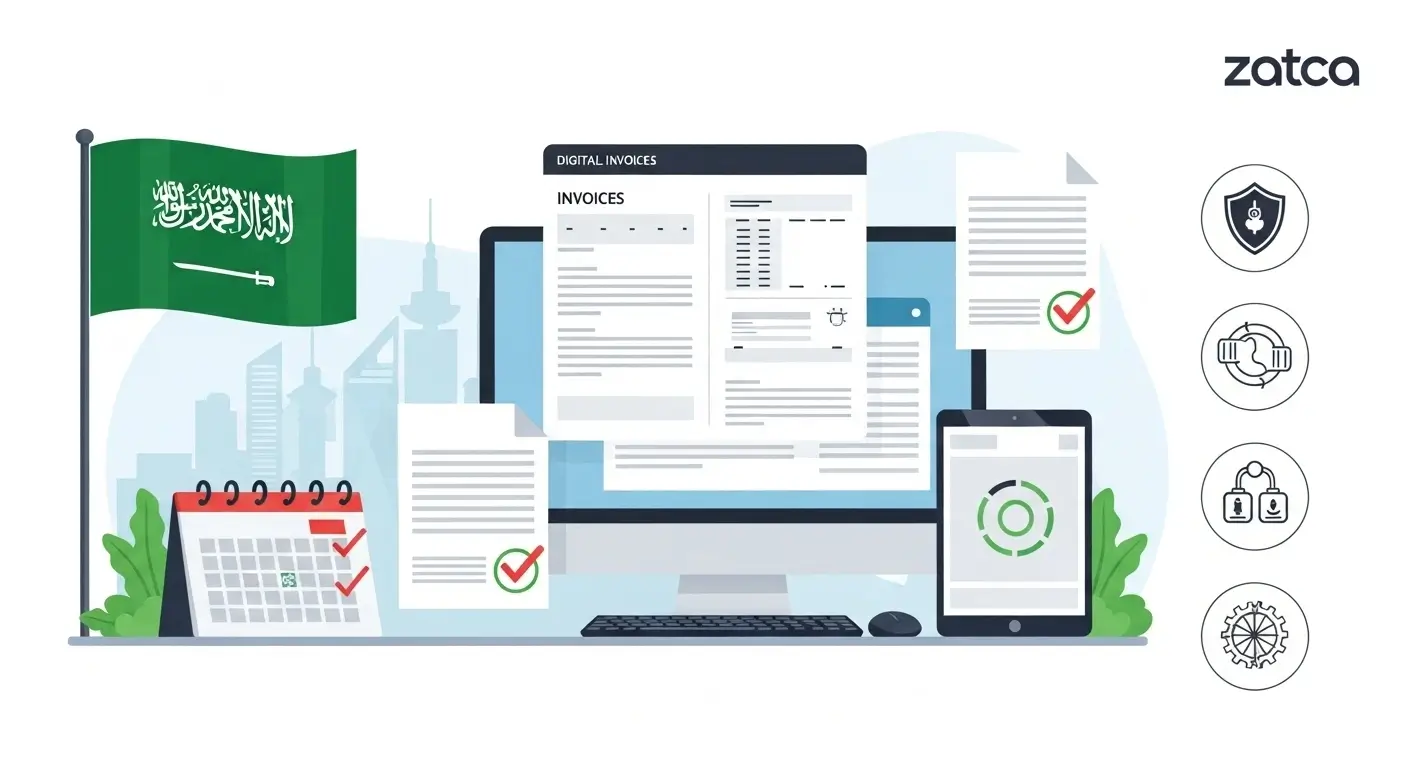
The commercial ecosystem in Saudi Arabia is experiencing a technological renaissance. Driven by Vision 2030, the Zakat, Tax and Customs Authority (ZATCA) has fundamentally altered how businesses record, transmit and validate financial transactions. What began as a foundational digital shift has evolved into a strict, near-real-time reporting mandate, and a passive approach to tax compliance is now a direct operational risk.
The regulatory spotlight has moved firmly onto small and medium enterprises. Each successive integration wave lowers the revenue threshold, pulling thousands more organisations into scope. Connecting your billing architecture to the government’s Fatoora platform is no longer an optional upgrade. This guide dissects the layers of the Integration Phase, outlines the real cost of non-compliance, and equips decision-makers to select the right technology partner — because staying ZATCA compliant with e-invoicing is what protects both profitability and peace of mind.
Decoding the Implementation Phases: From Generation to Integration
To grasp the magnitude of the current mandate, executives must understand the trajectory of the Kingdom’s e-invoicing programme. ZATCA designed this rollout in two distinct stages, each carrying very different technical demands.
Phase 1: The Generation Era (December 2021)
The inaugural phase was a technological warm-up for the Saudi market. Its objective was to eliminate handwritten receipts and easily manipulated paper records.
During this period, VAT-registered entities had to use compliant electronic systems capable of generating standardised digital invoices. For Business-to-Consumer (B2C) transactions, that meant printing a simplified tax invoice with a foundational QR code. These systems remained isolated, however; they were not required to transmit data automatically to the government. A company using an offline point-of-sale terminal stayed compliant as long as the digital format was preserved locally.
Phase 2: The Integration and Connectivity Era (2023 – Present)
Phase 2 — rolling out in revenue-based waves since January 2023 — represents a leap in regulatory sophistication. This stage requires business software to communicate directly with ZATCA’s servers in real time or near-real time.
The phase splits the invoicing process according to the recipient of the goods or services:
- The clearance model (B2B and B2G): when transacting with another business or a government entity, the invoice cannot be legally issued to the buyer immediately. Your accounting software must transmit the XML payload via API to the Fatoora platform. ZATCA validates the data, applies a cryptographic stamp, and returns the cleared invoice to your system. Only then can the document be legally presented to your client.
- The reporting model (B2C): for retail transactions with individual consumers, a real-time clearance delay at the checkout counter is impractical. Retailers therefore issue a simplified tax invoice instantly, complete with a locally generated Phase 2 QR code, and the system then has a 24-hour window to report those transactions to the authority.
Managing these simultaneous workflows manually is not realistic. A specialised electronic invoice solution for KSA is the only practical way to run both pathways cleanly.
Who Bears the Burden of Compliance?
A pervasive and dangerous misconception in the Saudi business community is that enforcement targets only large corporations. The current wave timeline definitively ends that myth.
The Expanding Regulatory Net
The integration mandate applies to every VAT-registered taxpayer operating in the Kingdom (excluding non-resident taxable persons). The Authority notifies targeted groups at least six months before their mandatory go-live date. Waiting passively for that notification before starting a software upgrade is a strategic mistake.
Consider the recent enforcement trajectory:
- Wave 23: targeted businesses with VAT-taxable revenue above SAR 750,000 in 2022, 2023 or 2024, with a compliance deadline of 31 March 2026.
- Wave 24: lowered the threshold to SAR 375,000, with a deadline of 30 June 2026 — now closed.
- Wave 25: announced on 24 July 2026, halving the threshold again to SAR 187,500 of VAT-taxable revenue in any of the years 2022 to 2025, with a Fatoora integration deadline of 1 February 2027.
The direction of travel is unmistakable: each wave halves the threshold, and the mandate is converging on effectively every VAT-registered business in the Kingdom. If your organisation has crossed the mandatory VAT registration threshold in any recent fiscal year, assume integration is imminent. Proactive preparation prevents the rushed, error-prone deployments that happen when a deadline is weeks away.
One further point worth knowing: ZATCA has extended its fines cancellation and penalty exemption initiative to 31 December 2026. Coverage conditions apply, so confirm scope directly with the Authority before relying on it.
Prepare your technical infrastructure smoothly for ZATCA Phase 2 integration requirements.
The True Cost of Non-Compliance: Beyond Simple Fines
Failing to meet Phase 2 specifications carries consequences well beyond an administrative slap on the wrist. Non-compliance is a multifaceted threat capable of paralysing commercial operations.
A Breakdown of Enterprise Risks
|
Risk category |
Direct impact on business operations |
|
Direct financial penalties |
ZATCA applies escalating fines. Failure to issue or archive compliant e-invoices attracts penalties starting at SAR 5,000, while deletion or tampering with issued invoices carries a higher minimum, with statutory ceilings reaching SAR 50,000 per violation depending on the breach and its repetition. |
|
Cash flow paralysis |
If you issue a B2B invoice without the official cryptographic clearance stamp, your corporate client cannot claim that VAT as input tax. Their finance department will reject the invoice, freezing your payment cycle and squeezing working capital. |
|
Reputational damage |
In a competitive market, trust is currency. Presenting an invalid or un-scannable document signals to premium clients that your internal operations are risky to partner with. |
|
Operational suspension |
Continued disregard for electronic reporting mandates can lead to suspension of government services, blocking your ability to renew commercial registrations or process employee visas. |
Implementing robust e-invoicing software for Saudi Arabia neutralises these threats, turning a legal liability into an automated asset.
Selecting Your Technology Partner: The Five Critical Questions
The software market is saturated with vendors claiming full compliance. Many offer patchwork solutions that demand extensive manual uploads, which inevitably introduces human error. Before signing a contract, vet potential technology partners with these five non-negotiable questions:
- Do you possess official ZATCA approval and certification?
- Why it matters: your provider’s Electronic Generation Solution (EGS) must be recognised by the Authority. Unverified middleware exposes your data to rejection during the API handshake.
- Does your solution offer deep, bidirectional ERP and accounting integration?
- Why it matters: an isolated billing tool requires double data entry. A proper solution pulls data directly from your inventory and general ledger, executing clearance invisibly in the background.
- Are all specific invoice configurations natively supported?
- Why it matters: a retail shop needs different capabilities from a construction firm. Your software must differentiate automatically between standard tax invoices, simplified retail receipts, export invoices and electronic credit or debit notes.
- Is comprehensive onboarding, staff training and ongoing support included?
- Why it matters: deploying the technology is only the first hurdle. Your accounting and sales teams must know how to handle a rejected clearance attempt or an offline retail scenario without panicking.
- Does the architecture guarantee autonomous updates for future regulatory shifts?
- Why it matters: tax law is dynamic. ZATCA issued an updated version of its e-invoicing controls and technical specifications in May 2026, and schemas change. Your provider should push those updates globally without charging secondary consulting fees each time.
Overcoming Sector-Specific Challenges
Different industries face genuinely different hurdles when bridging daily operations with the government portal.
For retail chains handling thousands of daily transactions, speed is paramount. Cashiers cannot absorb a three-second delay while a receipt prints. A tailored retail and gold ERP setup ensures cryptographic stamping of simplified B2C invoices happens instantly offline, queuing those documents for bulk reporting within the permitted window.
Conversely, B2B service providers and manufacturers deal with milestone billing, retention amounts and advance payment scenarios. Their systems must generate precise XML payloads that accurately reflect fractional tax distributions across multiple linked documents. A generic, off-the-shelf package will usually fail to map these variables correctly.
The Daysum Solution: Total Compliance Mastery
Navigating the Integration Phase requires more than a software patch; it demands a digital architect. Daysum delivers an ecosystem designed specifically around ZATCA’s most demanding requirements.
Why Leading Saudi Firms Choose Daysum
- Direct API connectivity: our architecture communicates directly with the Fatoora platform. There are no manual XML uploads or batch processing delays; when your accountant clicks Confirm, the cryptographic handshake executes autonomously.
- Dynamic auto-generation: the system compiles the mandatory UBL 2.1 XML formats, generates the Phase 2 Base64 QR codes, and embeds the Universal Unique Identifiers without technical intervention from your staff.
- Holistic digital transformation: we do not just fix your billing. Through expert Odoo ERP implementation in Saudi Arabia, Daysum links your compliant invoicing module directly to warehouse inventory, CRM pipelines and core financial ledgers, creating a single source of truth.
By partnering with Daysum, leaders remove tax-compliance anxiety from the daily agenda and redirect attention to growth.
Strategic Conclusion: Act Before the Wave Breaks
The transition from paper ledgers to real-time, API-driven tax reporting is the most significant commercial change in modern Saudi business practice. ZATCA has drawn a clear line, and the leniency of the early years is expiring.
Waiting until the final weeks before your designated wave deadline practically guarantees integration bottlenecks, rushed staff training and technical failures. Early adoption gives your workforce time to adapt, allows proper sandbox testing, and protects revenue against sudden invoice rejections.
Do not let outdated technology compromise your reputation. Contact Daysum today to secure your Phase 2 readiness and let our team future-proof your enterprise.
Frequently Asked Questions (FAQs)
ZATCA regulations anticipate temporary connectivity issues for retail environments. If your internet drops, a compliant Phase 2 system will temporarily pivot to offline mode. It will continue to generate simplified B2C invoices locally, applying a unique internal cryptographic stamp and QR code so your customers can leave with valid receipts. The moment the internet is restored, the software will automatically sync and "report" the queued batch of offline invoices to the Fatoora portal, provided this happens within the legally mandated 24-hour window.
Far far away, behind the word mountains, far from the countries Vokalia and Consonantia, there live the blind texts. Separated they live in Bookmarksgrove right at the coast
It depends heavily on the architecture of your legacy system. While some highly advanced older systems can be bridged using specialized API middleware, many antiquated on-premise tools cannot natively generate the required XML structures or support the cryptographic hashing protocols. In many cases, attempting to "patch" an obsolete system ends up being more expensive and far less reliable than migrating to a modern, natively compliant cloud ERP solution.
The cryptographic stamp functions as an unforgeable digital signature. It mathematically binds the invoice data (such as the totals, dates, and buyer details) to that exact moment in time. If a malicious actor attempts to alter a single digit on the invoice after it has been stamped, the cryptographic hash will immediately break, instantly alerting auditors that the document has been tampered with. It ensures total data immutability.
No, this is a highly dangerous misinterpretation of the law. While ZATCA has occasionally extended specific initiatives to waive financial penalties for past, corrected errors (such as a merchant coming forward to fix previous VAT miscalculations), these waivers do not exempt any business from the foundational mandate to integrate their systems by their assigned Wave deadline. Failing to connect your API to the Fatoora platform on time remains a direct violation subject to immediate operational sanctions.