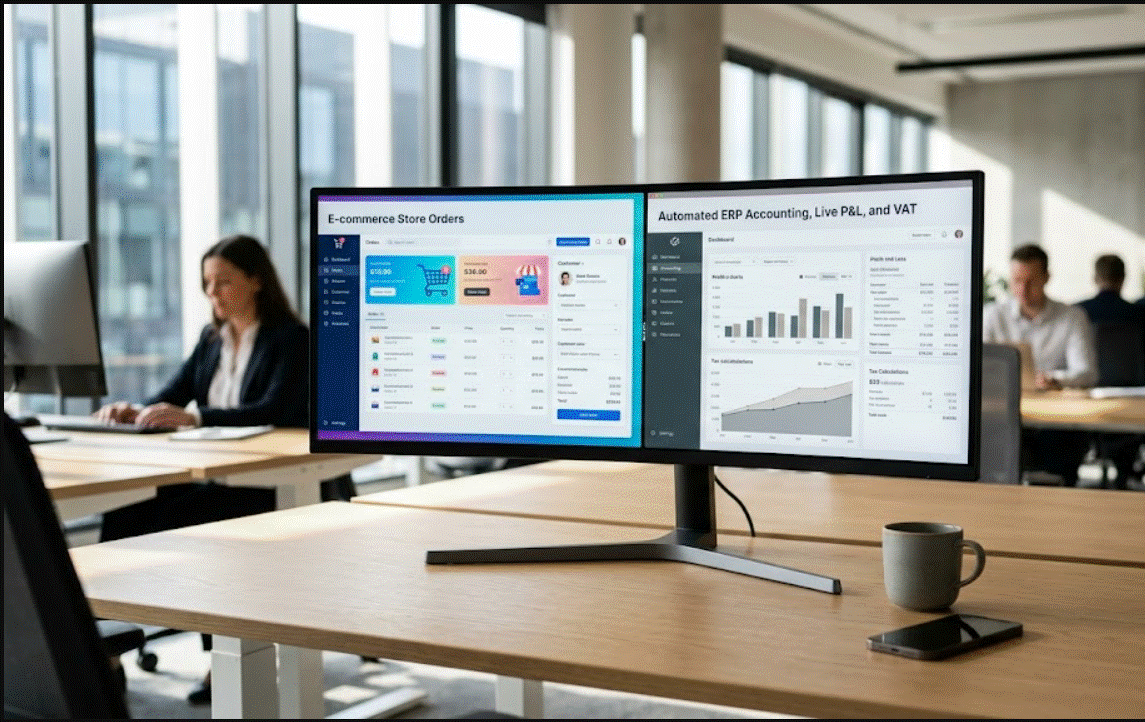
The digital commerce landscape across the Middle East is evolving at an unprecedented pace. For merchants and distributors operating in vibrant, high-demand markets like Riyadh, Cairo, and Dubai, E-commerce is no longer a secondary sales channel; it is the primary engine of commercial growth. Among the platforms driving this digital revolution, Salla stands out as a dominant force, empowering thousands of retailers and wholesale businesses to launch and scale their online operations seamlessly. However, as your order volume surges from a dozen transactions a day to hundreds or thousands, the initial excitement of rapid growth is often overshadowed by a severe operational bottleneck: the back-office accounting chaos.
Managing a high-traffic online store in isolation from your core financial systems creates a grueling, error-prone environment. When retail and B2B wholesale merchants rely on human intervention to transfer data between their storefront and their financial ledgers, they fall into the manual data entry trap. This operational fragmentation drains resources, delays financial reporting, and jeopardizes tax compliance. The definitive solution to this modern commercial challenge is implementing a robust Salla accounting integration. In this comprehensive guide, we will explore how linking your Salla store to a centralized Enterprise Resource Planning (ERP) system permanently eradicates the manual data entry nightmare, optimizes your inventory, and grants you absolute control over your financial destiny.
1. The Hidden Costs of Isolated Salla Management
For many growing enterprises, Salla management begins as a straightforward process. You upload products, set prices, and process orders directly through the platform’s dashboard. However, as your business model matures—especially if you are handling B2B wholesale accounts, managing multiple physical warehouses, or operating retail branches alongside your online store—this isolated approach becomes a critical liability.
When your Salla storefront is disconnected from your central accounting software, your financial and operational teams are forced to bridge the technological gap manually. This manifests in several deeply damaging ways:
- The Manual Entry Bottleneck: Accountants are forced to spend hours exporting CSV files from Salla and manually typing customer details, product SKUs, payment gateway fees, and shipping costs into a separate accounting program. This is not just a waste of expensive human capital; it is a highly demoralizing task that stifles employee productivity.
- Inevitable Human Error: The more data your team processes manually, the higher the probability of typographical errors. A misplaced decimal point or a duplicated invoice can completely distort your financial reality, leading to catastrophic miscalculations in inventory valuation and tax liabilities.
- Inventory Discrepancies and Overselling: If a wholesale client purchases a large batch of goods from your physical warehouse in Riyadh, your Salla store will not reflect this inventory reduction until a staff member manually updates the stock levels. This lag frequently results in overselling, out-of-stock cancellations, and severely damaged customer relationships.
- Delayed Strategic Decisions: When financial data is siloed and requires days of manual reconciliation, executives cannot access real-time insights. You are essentially navigating your business looking in the rearview mirror, unable to pivot quickly in response to market demands.
To understand how modern enterprises are overcoming these operational hurdles, you can explore the importance of e-invoicing in enhancing business efficiency.
2. Defining Salla Accounting Integration: Centralized Control
Salla accounting integration is the technological bridge that seamlessly and automatically connects your Salla e-commerce storefront to your backend ERP system. Utilizing secure Application Programming Interfaces (APIs), this integration ensures that the two systems communicate in real-time, functioning as a single, unified corporate ecosystem.
For wholesale distributors and retail merchants, this integration is the ultimate added value. It means that the moment a customer clicks “Complete Purchase” on your Salla store, a synchronized chain reaction occurs within your ERP without a single keystroke from your staff. The inventory is instantly deducted across all linked warehouses, the customer’s profile is created or updated in your CRM, the shipping order is generated for the logistics team, and the financial invoice is automatically drafted.
This level of automation transforms Salla accounting software from a basic record-keeping tool into a strategic asset. By centralizing your operations, you eliminate the friction between your online sales channels and your physical operations, allowing your management team to focus entirely on scaling the business and penetrating new regional markets.
Operational Comparison: Manual Salla Management vs. Automated ERP Integration
| Operational Metric | Isolated Salla Management (Manual Data Entry) | Automated Salla Accounting Integration | Impact on B2B & Retail Merchants |
| Data Transfer Speed | Takes hours or days; relies on batch CSV exports and manual typing. | Instantaneous and real-time; data flows the millisecond an order is placed. | Accelerates order fulfillment and entirely frees up the accounting team’s schedule. |
| Inventory Accuracy | High risk of overselling due to delayed synchronization between physical stores and Salla. | Unified stock levels across all channels; immediate deduction upon sale. | Protects brand reputation, prevents stockouts, and optimizes warehouse replenishment. |
| Financial Reconciliation | Complex, frustrating manual matching of payment gateway deposits against individual orders. | Automatic matching of gateway settlements, accounting for gateway fees automatically. | Ensures pristine, audit-ready financial records and accelerates the month-end closing process. |
| Scalability Potential | Severely limited; increased sales volume requires hiring more data entry clerks. | Infinite scalability; the system handles 10 orders or 10,000 orders with the exact same efficiency. | Enables aggressive commercial expansion into new markets without increasing administrative overhead. |
3. Financial Precision: Automating Journal Entries and Profit Tracking
The backbone of any successful commercial enterprise is the uncompromising accuracy of its financial ledgers. In a disconnected environment, translating E-commerce activities into proper accounting terminology is a massive headache.
The Automation of Journal Entries
With a robust Salla accounting software integration, the nightmare of manual bookkeeping is permanently eliminated. The ERP system is programmed to handle complex accounting logic automatically. When a transaction occurs on Salla, the ERP instantly generates perfectly balanced double-entry Journal entries.
For example, if a customer purchases a product using a credit card:
- The system automatically debits your specific “Payment Gateway Clearing” account.
- It credits your “E-commerce Revenue” account.
- It calculates and credits the “VAT Liability” account precisely.
- Simultaneously, it debits the “Cost of Goods Sold (COGS)” and credits the “Inventory Asset” account to reflect the movement of stock.
This happens in the background, flawlessly, thousands of times a day. Furthermore, when the payment gateway (like Mada, Visa, or Tamara) deposits the funds into your bank account, the system can automatically reconcile the deposit, intelligently separating the actual revenue from the gateway’s processing fees.
Real-Time Profit and Loss Visibility
Because every sale, return, shipping fee, and operational cost is recorded instantly through these automated Journal entries, your executive team gains unprecedented access to a live Profit and loss (P&L) statement. You no longer have to wait until the 15th of the following month to know if your recent marketing campaign was profitable. You can view your gross margins, operating expenses, and net profit in real-time. This visibility allows B2B and retail merchants to make agile, data-driven decisions regarding pricing strategies, bulk discounts, and inventory procurement.
To discover more about how data analytics can transform your commercial approach, learn how to analyze sales data to improve strategies.
4. Perfecting E-commerce Sales Tracking and VAT Compliance
As governments across the region, particularly in Saudi Arabia and the UAE, implement strict digital tax frameworks, compliance is no longer optional—it is a critical requirement for business survival.
Bulletproof VAT Compliance
Operating an E-commerce store means dealing with a high volume of invoices, and any miscalculation in VAT (Value Added Tax) can trigger severe financial penalties from regulatory bodies like the Zakat, Tax and Customs Authority (ZATCA). A direct ERP integration guarantees that the VAT applied on your Salla store perfectly matches your internal accounting records.
The ERP system automatically generates fully compliant electronic tax invoices for every Salla order. It ensures that the mandatory cryptographic stamps, UUIDs, and QR codes are embedded seamlessly. When it is time to file your tax returns, your finance team simply generates a highly accurate, automated tax report, transforming a stressful week-long auditing process into a five-minute task.
Omnichannel Sales Management
For businesses that operate both B2B wholesale distribution and direct-to-consumer online retail, tracking overall performance can be convoluted. A centralized ERP system consolidates your Sales data from Salla with the sales generated by your on-the-ground sales representatives and physical POS systems.
This omnichannel visibility allows you to track customer lifetime value comprehensively. You can easily identify which B2B clients are also purchasing through your retail portal, analyze seasonal buying trends, and construct highly targeted loyalty programs based on accurate, consolidated purchasing histories.
For further insights into scaling your operations securely, read about how e-invoicing business growth acts as a catalyst for enterprise expansion.
The ROI and Strategic Benefits of Salla Accounting Software Integration
| Strategic Benefit | Technological Mechanism | Direct Value Added for B2B & Retail Merchants |
| Drastic Cost Reduction | Eliminating the need for dedicated manual data entry personnel. | Redirects payroll budget toward strategic roles like sales, marketing, and business development. |
| Absolute Tax Security | Automated, error-free VAT calculation and generation of compliant electronic invoices. | Protects the enterprise from hefty governmental fines and ensures completely stress-free audits. |
| Enhanced Customer Experience | Instant order processing and real-time inventory updates preventing stockouts. | Builds profound brand trust, encourages repeat business, and elevates overall customer satisfaction. |
| Data-Driven Leadership | Continuous, automated updating of Profit and loss statements and cash flow dashboards. | Empowers CEOs and founders to make rapid, highly informed decisions based on live, uncompromised data. |
5. Why Daysum and Odoo ERP are the Ultimate Solution for Salla Merchants
Achieving this level of flawless automation requires a platform that is not only powerful but also highly flexible and tailored to the unique economic landscape of the Middle East. Generic, rigid software solutions often fail to accommodate the complex workflows of wholesale businesses or the specific localized tax rules required in the region.
This is where the combination of Odoo Community and Daysum’s expert implementation shines as the premier choice. By connecting Salla to Daysum ERP accounting, you leverage a world-class, open-source framework that has been meticulously localized for your specific market.
As a verified integrator, Daysum does not just plug your store into a generic system; they architect a comprehensive digital ecosystem. They ensure that your multi-warehouse inventory logic, your specific B2B pricing tiers, and your complex shipping matrices are perfectly mirrored in the integration. With secure cloud hosting, daily backups, and an interface that effortlessly handles both Arabic and English, Daysum’s solution guarantees that your transition from manual chaos to automated excellence is smooth, secure, and infinitely scalable.
For specialized sectors, Optimizing your precious metals inventory becomes seamless when you leverage Diamond POS GIA Tracking Saudi.
Conclusion
The era of managing your Salla online store in a vacuum is over. As your E-commerce operations expand and the demands of B2B and retail clients intensify, clinging to manual data entry is a surefire way to stunt your growth and invite catastrophic financial errors. By embracing a comprehensive Salla accounting integration, you do much more than just connect two pieces of software. You automate your Journal entries, ensure absolute VAT compliance, gain real-time visibility into your Profit and loss, and unify your Sales channels. It is time to step out of the manual data entry nightmare and step into the future of automated, intelligent, and highly profitable commerce, powered by an advanced ERP ecosystem.
Frequently Asked Questions (FAQs)
Not at all. The integration works entirely in the background via secure APIs. Your marketing and fulfillment teams can continue using the intuitive Salla dashboard just as they always have to manage products and process online orders. The difference is that all the heavy lifting—inventory deductions, financial ledger updates, and tax calculations—happens automatically within the ERP system without requiring any double entry.
This is one of the most powerful features of advanced Salla accounting software. The ERP is programmed to understand that a 100 SAR sale paid via a credit card might only result in a 97.5 SAR bank deposit. The system automatically creates the Journal entries to record the full 100 SAR as revenue, instantly deducting the 2.5 SAR as a payment processing expense. When the bank statement is uploaded, the reconciliation process is virtually automatic, saving your accounting team countless hours.
Yes, absolutely. A sophisticated ERP system allows you to configure advanced analytical accounting and cost centers. When the integration is set up correctly, the system can automatically tag orders originating from your Salla store differently than large bulk orders processed directly by your sales team. This provides you with clear, segmented Profit and loss reports, allowing you to analyze the specific profitability of your E-commerce division versus your traditional wholesale operations.
Yes, it acts as your strongest line of defense. Because the ERP system is specifically localized for the regional market, every sale pushed from Salla triggers the automatic generation of a Phase-2 compliant electronic tax invoice. The system correctly calculates the VAT, applies the necessary cryptographic stamps, generates the required QR codes, and ensures that your digital records are perfectly aligned with governmental regulations, keeping your business safe from compliance penalties.